
Millets vs Rice: Which Is Better for Your Health?
Introduction
Rice has been a staple food in Indian households for centuries. From steamed rice and biryani to dosa and idli, it forms the foundation of countless traditional meals. However, in recent years, millets have gained tremendous popularity as people become more conscious about healthy eating and balanced nutrition.
Health experts, nutritionists, and fitness enthusiasts are increasingly recommending millets as an alternative to refined grains. Rich in fiber, protein, vitamins, minerals, and antioxidants, millets are often called the “super grains” of India.
But does that mean rice is unhealthy? Should you completely replace rice with millets? Or can both be part of a balanced diet?
This comprehensive comparison explores the nutritional differences, health benefits, and practical uses of millets and rice to help you make informed dietary choices.
What Are Millets?
Millets are ancient cereal grains that have been cultivated in India for thousands of years. They are small-seeded grasses known for their nutritional richness and environmental sustainability.
Popular varieties include:
- Ragi (Finger Millet)
- Bajra (Pearl Millet)
- Jowar (Sorghum)
- Foxtail Millet
- Little Millet
- Barnyard Millet
- Kodo Millet
- Proso Millet
Millets are naturally gluten-free and highly versatile in cooking.
What Is Rice?
Rice is one of the world’s most widely consumed cereals and an important part of Indian cuisine.
The most common types include:
- White Rice
- Brown Rice
- Basmati Rice
- Red Rice
- Black Rice
White rice is the most commonly consumed variety but undergoes processing that removes much of its bran and germ, reducing its nutritional value.
Nutritional Comparison
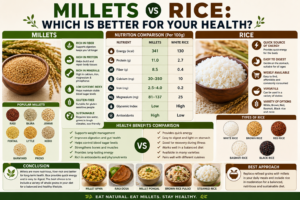
Although both millets and rice provide carbohydrates for energy, millets generally contain higher amounts of essential nutrients.
| Nutrient | Millets | White Rice |
|---|---|---|
| Fiber | High | Low |
| Protein | Moderate to High | Moderate |
| Calcium | High (especially Ragi) | Low |
| Iron | Higher | Lower |
| Magnesium | High | Low |
| Antioxidants | Rich | Limited |
| Glycemic Index | Lower | Higher |
| Gluten | Gluten-Free | Gluten-Free |
Millets offer a more nutrient-dense profile, making them a valuable addition to healthy diets.
1. Millets Are Richer in Fiber
Dietary fiber plays an important role in maintaining digestive health.
Millets contain significantly more fiber than polished white rice.
Benefits of fiber include:
- Better digestion
- Improved gut health
- Reduced hunger
- Better weight management
- Regular bowel movements
White rice, particularly polished rice, contains much less fiber because much of it is removed during processing.
Winner: Millets
2. Millets Support Weight Management
People trying to lose weight often seek foods that keep them full for longer.
Millets digest more slowly because of their higher fiber content.
This helps:
- Reduce appetite
- Prevent overeating
- Control cravings
- Maintain energy levels
Rice, especially white rice, digests more quickly and may leave people feeling hungry sooner.
Winner: Millets
3. Blood Sugar Management
Many millet varieties have a lower glycemic index compared to white rice.
A lower glycemic index means food releases glucose slowly into the bloodstream.
This gradual release helps:
- Maintain stable energy
- Reduce sudden sugar spikes
- Improve meal satisfaction
White rice generally has a higher glycemic index, which may lead to quicker increases in blood sugar levels.
Winner: Millets
4. Bone Health
Ragi, one of the most popular millets, is one of the richest natural sources of plant-based calcium.
Calcium supports:
- Strong bones
- Healthy teeth
- Muscle function
- Bone density
Rice contains much lower amounts of calcium.
Winner: Millets
5. Protein Content
Protein is essential for muscle maintenance and overall body function.
Many millet varieties provide more protein than polished rice.
Protein helps:
- Build muscles
- Repair tissues
- Support metabolism
- Increase satiety
While rice does contain protein, millets generally provide a better nutritional balance.
Winner: Millets
6. Digestive Health
The fiber present in millets supports a healthy digestive system.
Benefits include:
- Better nutrient absorption
- Improved bowel regularity
- Healthy gut bacteria
- Reduced digestive discomfort
White rice is easier to digest but lacks the fiber that contributes to long-term digestive health.
Winner: Millets
7. Long-Lasting Energy
Millets are complex carbohydrates that provide sustained energy.
This makes them ideal for:
- Students
- Working professionals
- Athletes
- Active individuals
White rice offers quick energy but may also lead to faster energy decline.
Winner: Millets
8. Gluten-Free Benefits
Both rice and millets are naturally gluten-free.
This makes them suitable alternatives for people avoiding wheat-based foods.
Millets, however, provide additional nutrients alongside their gluten-free nature.
Winner: Tie
9. Environmental Sustainability
Millets are among the most environmentally friendly crops.
Compared to rice cultivation, millets:
- Need less water
- Require fewer fertilizers
- Grow in dry climates
- Need fewer agricultural inputs
Rice farming often consumes significantly larger amounts of water.
Winner: Millets
10. Variety and Versatility
Rice is incredibly versatile and deeply rooted in Indian cuisine.
It can be prepared as:
- Steamed rice
- Biryani
- Fried rice
- Idli
- Dosa
- Pongal
Millets are equally versatile and can be used in:
- Millet dosa
- Millet idli
- Millet upma
- Millet pongal
- Millet khichdi
- Millet pulao
- Millet pancakes
Both grains offer excellent culinary possibilities.
Winner: Tie
Types of Rice and Their Health Value
Not all rice is the same.
White Rice
- Highly processed
- Low fiber
- Quick cooking
- Easy digestion
Brown Rice
- More fiber
- More nutrients
- Better than polished white rice
Red and Black Rice
- Rich in antioxidants
- Higher nutritional value
- Good source of minerals
Choosing less processed rice varieties can improve nutritional intake.
Can You Replace Rice Completely?
There is no need to eliminate rice entirely.
A balanced approach is often the best solution.
Many nutritionists recommend:
- Replacing some rice meals with millets
- Rotating different millet varieties
- Combining millets and rice for diversity
This approach provides a broader range of nutrients while maintaining traditional food habits.
Easy Ways to Include Millets in Your Diet
Breakfast
- Millet dosa
- Millet idli
- Millet porridge
- Millet pancakes
Lunch
- Millet rice
- Millet pulao
- Millet khichdi
Dinner
- Millet upma
- Millet pongal
- Millet rotis
Healthy Snacks
- Millet cookies
- Millet energy bars
- Roasted millet snacks
Who Should Eat More Millets?
Millets can be beneficial for:
- Health-conscious individuals
- Fitness enthusiasts
- Growing children
- Older adults
- Busy professionals
- Families seeking balanced nutrition
Rice can still remain part of a healthy diet when consumed in moderation and combined with vegetables, pulses, and proteins.
Millets vs Rice: Quick Comparison
| Factor | Millets | Rice |
|---|---|---|
| Fiber | ⭐⭐⭐⭐⭐ | ⭐⭐ |
| Protein | ⭐⭐⭐⭐ | ⭐⭐⭐ |
| Calcium | ⭐⭐⭐⭐⭐ | ⭐ |
| Blood Sugar Support | ⭐⭐⭐⭐⭐ | ⭐⭐ |
| Digestion | ⭐⭐⭐⭐ | ⭐⭐⭐ |
| Weight Management | ⭐⭐⭐⭐⭐ | ⭐⭐ |
| Sustainability | ⭐⭐⭐⭐⭐ | ⭐⭐⭐ |
| Versatility | ⭐⭐⭐⭐ | ⭐⭐⭐⭐ |
Which Is Better for Your Health?
The answer depends on your dietary needs, but from a nutritional perspective, millets generally offer more health benefits than polished white rice.
Millets provide:
✔ Higher fiber
✔ Better mineral content
✔ More protein
✔ Long-lasting energy
✔ Better digestive support
✔ Greater sustainability
However, rice remains an important part of Indian cuisine and can still be included as part of a balanced diet.
The healthiest approach is not to choose one over the other but to include a variety of whole grains in your meals.
Conclusion
The debate between millets and rice is not about declaring one completely good and the other bad. Instead, it is about understanding their nutritional differences and making smarter food choices.
Millets stand out because of their exceptional nutrient profile, higher fiber content, better support for digestion and weight management, and lower environmental impact. Rice, especially less processed varieties, also has its place in a balanced diet.
By incorporating millets into your weekly meal plan while enjoying rice in moderation, you can benefit from the strengths of both grains.
As more people return to traditional, wholesome foods, millets are proving that ancient grains still have an important role in modern healthy living.