
Why Millets Are a Sustainable Food Choice: Benefits for Your Health, Farmers, and the Planet
Introduction
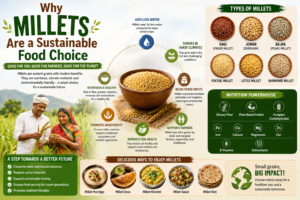
As the world faces challenges such as climate change, water scarcity, soil degradation, and growing food demand, the need for sustainable food choices has never been greater. Consumers today are increasingly looking for foods that are not only nutritious but also environmentally responsible. Among the many grains available, millets stand out as one of the most sustainable and resilient crops.
Millets have been cultivated in India and many parts of Asia and Africa for thousands of years. Once considered traditional staple grains, they are now gaining global recognition for their nutritional value, climate resilience, and eco-friendly cultivation practices. Rich in dietary fiber, plant-based protein, vitamins, minerals, and antioxidants, millets offer health benefits while also supporting sustainable agriculture.
Unlike many resource-intensive crops, millets generally require less water, thrive in dry regions, and grow well with fewer agricultural inputs. Their ability to adapt to challenging environments makes them an important crop for the future of food security.
In this guide, you’ll discover why millets are considered a sustainable food choice, how they benefit the environment and farming communities, and simple ways to include these ancient grains in your daily meals.
What Are Millets?
Millets are small-seeded cereal grains that belong to a group of hardy grasses cultivated for centuries. They are naturally nutritious, versatile, and suitable for a wide range of recipes.
Popular varieties include:
- Foxtail Millet
- Ragi (Finger Millet)
- Jowar (Sorghum)
- Bajra (Pearl Millet)
- Little Millet
- Barnyard Millet
- Kodo Millet
- Proso Millet
These grains are commonly used to prepare rotis, dosas, porridges, pulao, khichdi, salads, snacks, and baked foods.
What Makes a Food Sustainable?
A sustainable food supports both people and the planet. In general, sustainable crops:
- Use natural resources efficiently
- Require fewer agricultural inputs
- Support biodiversity
- Help farming communities
- Contribute to long-term food security
Millets meet many of these criteria, making them an excellent choice for environmentally conscious consumers.
1. Millets Require Less Water
One of the biggest advantages of millets is their relatively low water requirement compared with many major cereal crops.
Because they can grow successfully in regions with limited rainfall, millets help reduce pressure on freshwater resources.
This makes them especially valuable in areas affected by drought and changing weather patterns.
2. Grow Well in Dry and Challenging Climates
Millets are naturally hardy crops.
They can tolerate:
- Dry conditions
- High temperatures
- Poor soil quality
- Unpredictable rainfall
Their resilience makes them an important crop for climate-adaptive agriculture.
3. Need Fewer Agricultural Inputs
Compared with some other cereal crops, millets often require:
- Less irrigation
- Lower fertilizer inputs
- Reduced pesticide use
This can lower production costs and reduce environmental impact.
4. Support Biodiversity
Growing different millet varieties encourages agricultural diversity.
Crop diversity can:
- Improve farming resilience
- Reduce dependence on a single crop
- Support healthier farming systems
Traditional farming practices often include multiple millet varieties suited to local environments.
5. Help Improve Soil Health
Millets can play a role in sustainable farming systems by contributing to crop rotation and diversified agriculture.
Healthy crop rotations may help maintain soil quality over time and reduce reliance on continuous monoculture farming.
6. Support Small-Scale Farmers
Millets are widely grown by small and marginal farmers across India.
Because they are well adapted to local conditions, millet cultivation can provide reliable harvests even in areas with challenging climates.
Supporting millet-based agriculture can contribute to rural livelihoods and local food systems.
7. Contribute to Food Security
As global food demand increases, resilient crops become increasingly important.
Millets can help strengthen food security because they:
- Grow in diverse environments
- Adapt to climate variability
- Produce nutritious grains
These characteristics make them a valuable part of sustainable agriculture.
Nutritional Benefits of Millets
Sustainability is only one reason to choose millets.
They are also naturally rich in:
- Dietary fiber
- Complex carbohydrates
- Plant-based protein
- Iron
- Magnesium
- Zinc
- Potassium
- Phosphorus
- B Vitamins
- Antioxidants
These nutrients support balanced nutrition as part of a healthy diet.
Why Consumers Are Choosing Millets
Health-conscious families appreciate millets because they are:
- Whole grains
- Versatile
- Filling
- Easy to cook
- Suitable for many traditional and modern recipes
From breakfast to dinner, millets fit easily into everyday meals.
Delicious Ways to Enjoy Millets
Breakfast
- Millet upma
- Ragi porridge
- Millet idli
- Millet dosa
- Millet pancakes
Lunch
- Millet pulao
- Millet salad
- Millet khichdi
- Grain bowls
Dinner
- Jowar roti
- Bajra roti
- Vegetable millet soup
- Millet casseroles
Healthy Snacks
- Millet crackers
- Millet cookies
- Roasted millet snacks
- Energy bars
Millets and Sustainable Living
Choosing millets supports a lifestyle focused on responsible consumption.
Simple changes include:
- Replacing refined grains with whole millets
- Trying different millet varieties each week
- Buying locally produced millet products when available
- Reducing food waste by meal planning
Small choices can collectively contribute to more sustainable food systems.
Common Myths About Millets
Myth 1: Millets Are Old-Fashioned
Millets are being used in modern recipes such as pizzas, wraps, smoothies, burgers, and baked goods.
Myth 2: Millets Are Difficult to Cook
Most millet varieties are easy to prepare with simple cooking techniques.
Myth 3: Sustainable Foods Are Expensive
Millets are often affordable and widely available, making them an accessible option for many households.
Tips for Buying and Storing Millets
- Purchase from trusted brands.
- Store in airtight containers.
- Keep in a cool, dry place.
- Rotate stock regularly for freshness.
Proper storage helps maintain quality and flavor.
Frequently Asked Questions
Are millets environmentally friendly?
Yes. Millets generally require less water than many cereal crops, grow well in dry regions, and often need fewer agricultural inputs, making them a sustainable crop.
Why are millets called climate-resilient crops?
Millets are able to tolerate challenging growing conditions, including heat and limited rainfall, making them well suited to climate variability.
Can millets replace rice and wheat?
Millets can be used in place of or alongside rice and wheat in many recipes, adding variety and whole-grain nutrition to the diet.
Are millets suitable for everyday meals?
Yes. Millets can be included regularly as part of a varied and balanced diet.
Conclusion
Millets are much more than ancient grains—they represent a practical and sustainable solution for the future of food. Their ability to grow with less water, adapt to challenging climates, and support diverse farming systems makes them an environmentally responsible crop. At the same time, their impressive nutritional profile provides dietary fiber, plant-based protein, vitamins, minerals, and antioxidants that contribute to a balanced diet.
From traditional recipes like rotis, dosas, and porridges to modern dishes such as salads, wraps, pizzas, and grain bowls, millets offer endless possibilities for healthy and delicious meals. By choosing millets more often, consumers can enjoy wholesome food while supporting farming communities and encouraging more sustainable agricultural practices.
Making small changes—such as replacing refined grains with millets a few times each week—can benefit your health and contribute to a more resilient food system for future generations.